
Global Passport Index 2026: The Mobility Divide Is Widening


Top 5 passports in Americas
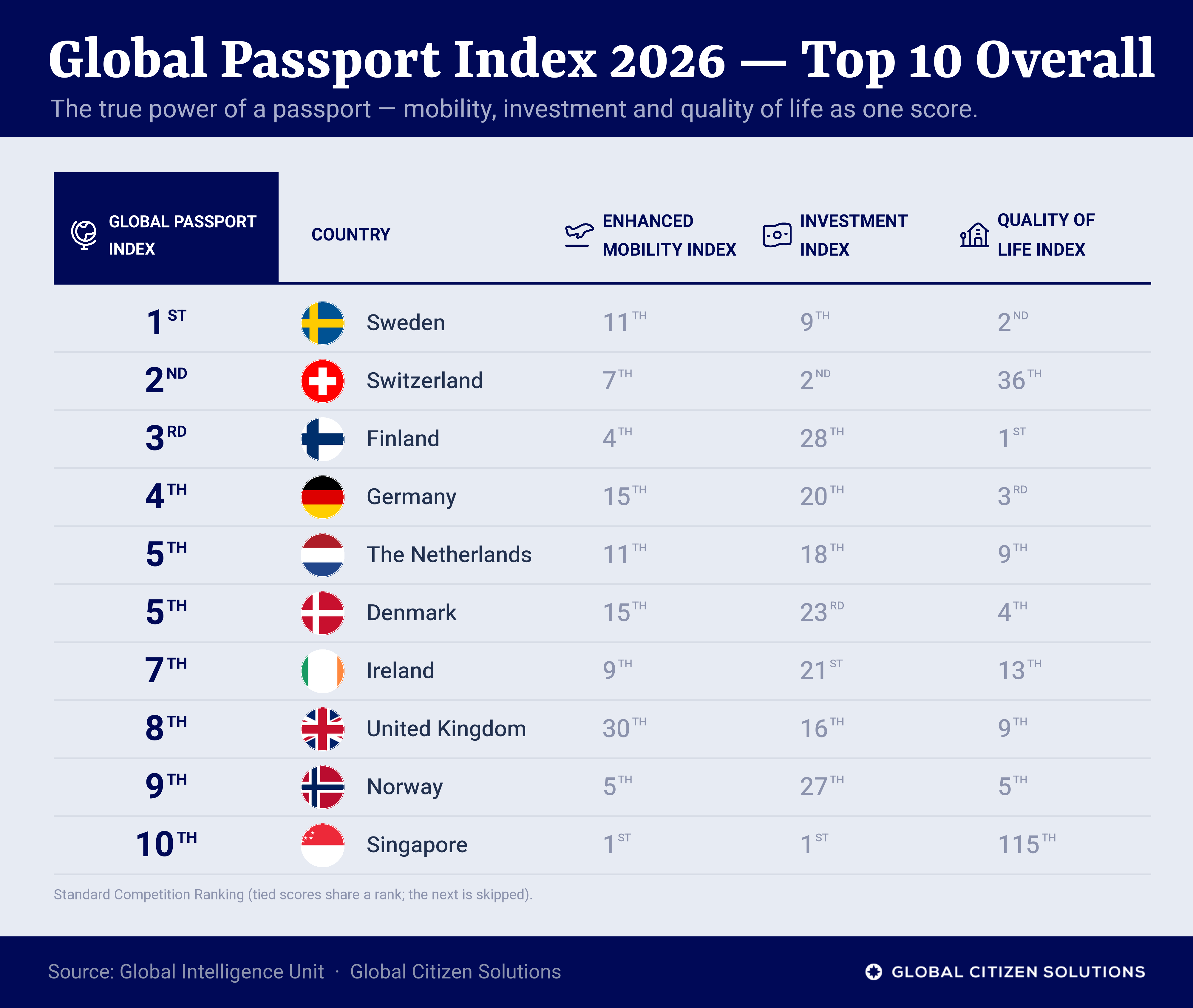
Top 10 passports globally
The gap between the world’s strongest and weakest passports is widest and US records steepest decline of any G7 country since GPI launched in 2021
A government that negotiates mobility for its citizens unlocks investment markets, expands their quality of life opportunities, and repositions the country in the global order.”
LONDON , UNITED KINGDOM, June 30, 2026 /EINPresswire.com/ -- Sub1: Sweden holds the top position for the third consecutive year— Dr. Laura Madrid, Lead Researcher, Global Citizen Solutions.
Sub2: The gap between the world’s strongest and weakest passports is now wider than at any point since the index launched in 2021
Sub3: The United States has fallen from 1st to 12th in five years, the steepest recorded decline of any G7 country in the GPI’s history
Sub4: The UAE surges 23 places in a single year to reach 3rd in the mobility sub-ranking, demonstrating that active bilateral diplomacy can produce rapid, measurable gains in passport strength
Sub5: Only 38.5% of the world’s bilateral country relations operate on a reciprocal visa basis; although the majority of the global mobility system is structurally asymmetric, i.e. a country may grant visa-free entry to nationals of a given state without that state extending equivalent treatment in return
Sub6: Caribbean citizenship-by-investment programs continue to deliver passport rankings far in excess of economic fundamentals, with GPI data confirming consistent outperformance by Saint Kitts and Nevis, Antigua and Barbuda, and Dominica
London — 30th June, 2026 — Global Citizen Solutions (“GCS”), a leading residency and citizenship planning advisory firm, today publishes the fifth annual edition of the Global Passport Index (GPI), the firm’s flagship research report ranking 199 countries’ passports on mobility access, investment attractiveness, and quality of life. Now in its fifth year, the 2026 edition finds that the global mobility divide — the gap between the most and least powerful travel documents in the world — is not narrowing, it is widening.
The GPI measures passport strength across three dimensions: mobility access (the number of countries reachable without a prior visa), investment attractiveness (tax environment, innovation, and economic competitiveness), and quality of life (healthcare, safety, climate, and social infrastructure). The composite score that results from these three pillars captures not just where holders can travel, but the full value of the country that stands behind their document. The gap between the world’s strongest passport (Sweden, 96.05) and weakest (Afghanistan, 23.1) has widened every year since the index launched in 2021.
Nine of the ten highest-ranking passports in 2026 belong to European states, with Singapore (10th) the sole non-European entry. The top ten spans a score range of barely three points — from Sweden’s 96.05 to Singapore’s 92.80 — reflecting the high degree of convergence among wealthy democracies on mobility access, economic competitiveness, and quality of life. Sweden’s sustained dominance is not driven by mobility alone: its mobility rank is 14th, not 1st. The ascent from 6th place in 2021 to first from 2024 onwards was powered by consistent, reinforcing improvement across all three GPI dimensions, including a quality of life rank of 2nd and an investment climate rank of 9th globally. Sweden’s dominance demonstrates that composite passport strength, at its most durable, reflects genuine excellence in governance and quality of life — not only mobility.
“What the Global Passport Index captures that conventional passport rankings cannot is the full picture of what a passport actually delivers. Mobility matters enormously and carries the highest weight (50%) amid all dimensions, but clients asking whether to pursue a second citizenship are also asking about investment environments, about healthcare, about where their children will be educated and so on. The GPI’s three-pillar structure exists because those questions are inseparable,” said Patricia Casaburi, CEO, Global Citizen Solutions.
The United States presents the index’s most significant case study in structural decline.
Having achieved the highest composite score in the GPI’s history in 2021 — ranking 1st globally with a score of 96.45 — it now ranks 12th with a score of 92.37, the steepest five-year fall of any G7 country. The primary driver is mobility: the US mobility rank has collapsed from 10th in 2021 to 41st in 2026, a 31-place decline. The most visible catalyst was Brazil’s reinstatement of visa requirements for American citizens in April 2025, explicitly citing the reciprocity principle. Strip out the investment and economic indicators — where the US remains consistently 3rd to 4th globally — and the US passport sits 41st on raw mobility: the measure that determines where an American can travel without joining a visa queue.
"The American passport is a story of diverging metrics. On raw travel freedom it has fallen from 10th in the world in 2021 to 41st in 2026, a 31-place slide that reflects how aggressively other nations have expanded visa-free access while the US has stood still, and in some cases lost ground, as countries such as Brazil reinstated visa requirements for American travelers. Yet it still ranks 12th overall, because mobility is only one measure of true strength”, explains Casaburi, CEO of Global Citizen Solutions. “Where the US passport remains formidable is investment: it sits 3rd globally on the GPI's Investment pillar, powered by the world's deepest capital markets and an unmatched consumer economy. Its weaker flank is quality of life, where it ranks only in the mid-30s, held back by cost-of-living, health, and personal-freedom indicators that its peers at the top of the table comfortably outperform."
The 2026 edition pays attention to the reciprocity structure underlying global mobility.
Only 38.5% of the world’s bilateral country relations operate on a reciprocal visa basis; the majority of the global system is deliberately asymmetric, with wealthy democracies granting each other open access while maintaining restrictions on middle- and low-income countries that do not impose equivalent restrictions in return. The United States produces the highest reciprocity balance score in the world — meaning American citizens benefit from more generosity from the rest of the world than the US extends in return — yet the US Visa Waiver Programme covers the nationals of only 43 countries, one of the most selective admission thresholds of any wealthy democracy. India represents the most consequential single instance of this asymmetry: it ranks 2nd globally on destination openness while its citizens rank 136th on outbound mobility, an openness not enjoyed by its citizens in return, a gap affecting a population of 1.43 billion people.
Eleanor LEGGE-BOURKE
Global Citizen Solutions
+351 934336384
eleanor@globalcitizensolutions.com
Visit us on social media:
LinkedIn
Legal Disclaimer:
EIN Presswire provides this news content "as is" without warranty of any kind. We do not accept any responsibility or liability for the accuracy, content, images, videos, licenses, completeness, legality, or reliability of the information contained in this article. If you have any complaints or copyright issues related to this article, kindly contact the author above.
